
![]() ![]() |
|
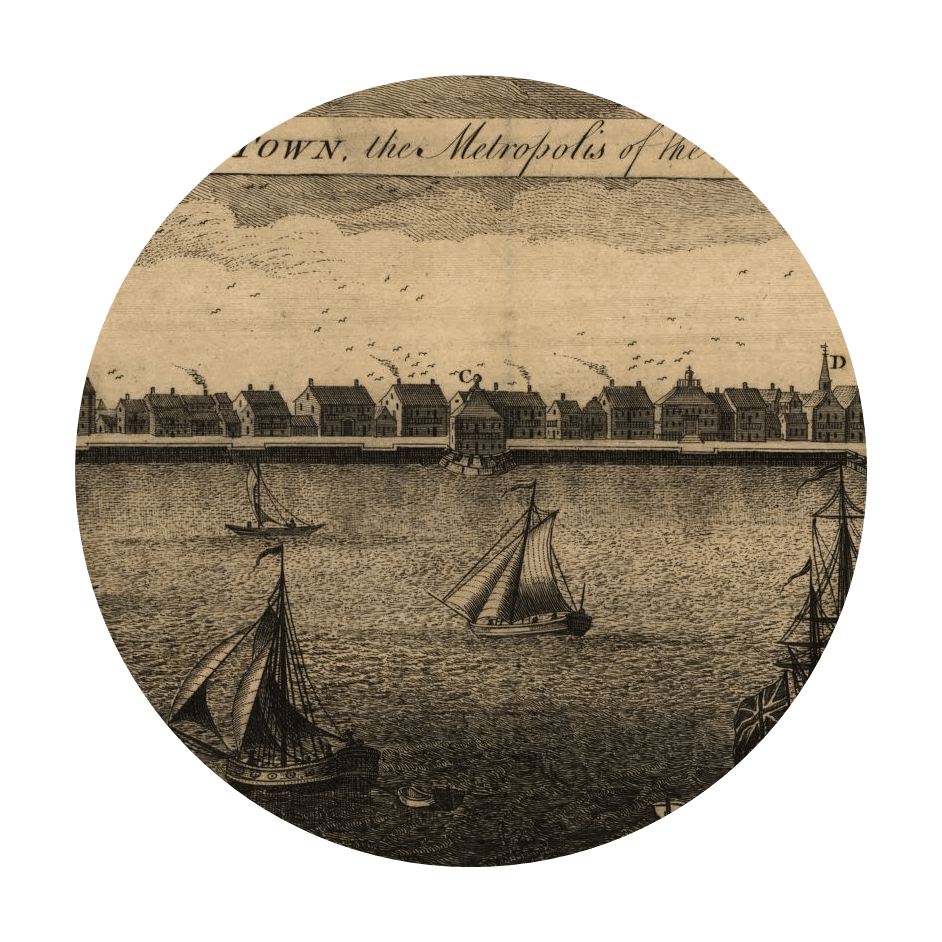
DID YOU KNOW . . . that George Washington visited Charleston in 1791? In 1791, the name Mount Pleasant still referred to a plantation rather than a town. As [George] Washington traveled the last few hundred yards to the Haddrells Point ferry landing, he passed woods and cornfields. A row of abandoned Revolutionary War barracks stood not far south of the highway. Just beyond a well-kept garden, he reached the Hibbens ferry settlement, where several buildings--including a ferry house and stables--had been erected to accommodate travelers. The public road ended at the junction of Shem Creek and Hog Island Channel; there the ferry made its daily crossings to and from Charleston. The scene that greeted
Washington at the landing was anything but usual. The citys emissaries
included the brothers-in-law Edward Rutledge and Charles Cotesworth--one
had signed the Declaration of Independence and the other had signed the
United States Constitution. Charlestons city recorder, John Bee
Holmes, appeared in robes of office and in the name of the city corporation
offered Washington an elegant twelve-oared barge. The custom house barge
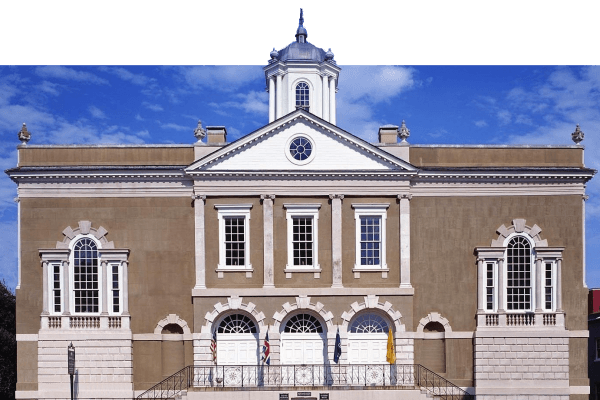
and fort boat stood ready to transport his retinue. Thirteen American sea captains manned the barge. Robert Cochran acted as coxswain; the other twelve pulled the oars. The captains were "uniformly and elegantly dressed in close short jackets of light blue silk, black florentine breeches, white silk stockings with light blue silk bow-knots in their shoes . . . [and] round black hats, with a light blue wide silk sash round the crowns, bearing an elegant impression of the arms of the state." Spectators packed the shore along East Bay Street, the streets, the windows, and the balconies. Offshore, they crowded the decks of every merchant ship anchored near the wharves. For over an hour, the crowd watched the pageantry on the river. When Washingtons barge drew near the landing site, "such a shout of joy took place as that one must see and hear all to have any thing like an adequate idea of it." The Charleston Artillery Battalion fired a fifteen-gun federal salute, and St. Michaels church bells--newly repaired at city expense--pealed joyfully in the background. When Washington landed in Charleston, some spectators glanced at the clock tower at St. Philips Church and noted the time--2:00 p.m. on Monday, 2 May 1791. Washington told those assembled he was ready to attend the festivities, asked [Arnoldus] Vanderhorst [the intendant or mayor] to proceed, and said he would follow. The fusileers opened files to let the city corporation march through. The sheriff, carrying the city mace, led the procession. Next came the messenger and marshal, the treasurer and clerk, the recorder in his robes, the wardens carrying their wands, and then Intendant Vanderhorst, who marched directly in front of Washington and his suite. After the president passed, a well-organized parade fell into place and followed him. When the procession reached the Exchange Building, one block south of Prioleaus Wharf, the politicians and clergy conducted Washington up the steps to the platform behind the balustrade. The Exchange, one of colonial Americas most elegant buildings, had been completed in 1771 as the provinces custom house and commercial center. Charleston had since acquired it and converted the second story into the city hall. As Washington looked up Broad Street from the buildings west front, he stood on the very spot where South Carolinas leaders had proclaimed the Declaration of Independence and the United States Constitution. From the Exchange, Washington acknowledged new salutes and volleys of artillery. The crowd lining the streets ranged "from superannuated old age to lisping infancy." Some of Charlestons citizens would long remember the sight of Washington standing on the porch of the Exchange when they were young children. The procession passed in review before Washington, and he exchanged courtesies with the various units as they marched by. The units then reversed course with the Cincinnati now in front. The dignitaries accompanied Washington downstairs and led the parade up Broad Street. Tuesday, May 3,
1791 The city council had invited the states political bigwigs. Charlestons foreign consuls, the clergy, the Cincinnati, the militia officers, and anyone else of note who either lived nearby or was visiting. Because so many guests crowded the banquet hall, the Charleston Artillery Battalion had to dine in a separate room. The Revolutionary War sailor Commodore Alexander Gillon had suggested place settings that surrounded Washington with interesting female company. Mrs. [John] Rutledge sat on his right, Claudia Smith -- reputedly the wittiest woman in Charleston -- sat on his left, and directly in front sat Susanna Shubrick -- said to be the most beautiful woman in Charleston. Washington had no complaints. After dinner, the guests drank the usual round of patriotic toasts, and the Charleston Artillery Battalion followed each toast with a volley of cannon--seventeen rounds by evenings end. At eight oclock, Washington rose from his chair and standing under the ingeniously-crafted triumphal arch and laurel wreath that had been suspended over his head all evening, he toasted "the city of Charleston, and prosperity to it." After he had gone, the guests drank a final toast to "the president of the United States." The newspaper report noted that "the day and evening were spent with all that hilarity, harmony, and happy festivity suitable to the occasion." Wednesday, May
4, 1791 As darkness fell, the building shone brilliantly. An arch of lamps burned in front of the entrance, and overhead a transparency illuminated the monogram "G.W." in large letters. Beneath the initials appeared the phrase "Deliciis Patriae" (beloved by the nation). A German Fusileer honor guard, freshly spit-and-polished, stood at attention in front of the building. Arriving guests proceeded to either the north or south stairwell and climbed one flight to the city hall chambers on the second story. An 1,840-square-foot "great hall" dominated the city councils quarters and served as Charlestons grand ballroom. For the evenings festivities, the arrangements committee had installed ample lighting and had entwined chaplets of laurel and flowers around the columns surrounding the dance floor. The newspaper reported that "a numerous and brilliant assemblage of ladies and a great number of gentlemen" attended. Washingtons description made no mention of the gentlemen, but he distinctly recalled "256 elegantly dressed & handsome ladies." The fifty-nine-year-old Washington had a commanding presence. His six-foot, 220-pound frame and his handsome face with its Roman nose and light greyish-blue eyes made him the center of attention at any public function. And when he attended a formal reception or ball, he dressed accordingly. If he entered the ballroom in his usual formal attire, he wore a black velvet suit with white ruffled shirt, black silk stockings, silver knee and shoe buckles, and highly varnished shoes. His hair was profusely powdered and fully dressed, with the queue gathered behind in a black silk bag tied with a solitaire. His gloves were yellow, and he carried a black silk-velvet cocked hat with a large black cockade on one side and inch-wide black feathers adorning the brim. A dress sword hung from his left hip, and a sword knot encircled the weapons finely-wrought polished hilt. He wore the sword under his coat so that the white leather scabbard projected beneath his coattails. Since South Carolina favored suits of indigo blue for men, Washingtons black velvet may have stood out in the Charleston crowd. The ladies upheld the citys reputation for rich and stunning fashions. On their headdresses, they sported Washington medallions surrounded by spangles and other ornaments. Their ribbons and bandeaus contained mottoes inscribed in gold and silver letters: "Long live the president, " "He lives the guardian of his countrys rights, " "Virtue and valor united," "Rejoice, the heros come," "Shield, oh! shield him from all harm," and many others. One lady displayed a fan on which someone had painted the goddess Fame surrounding her trumpet and crowning Washington with a laurel wreath. When Washington first entered the ballroom, he went to his place of honor and regally sat there for several minutes. Then he rose, went around the room, and bowed to each lady present. His gesture delighted everyone, for even guests in the far corners of the ballroom got their chance to see him at close range. Dancing assemblies were among Washingtons favorite pastimes, and he sometimes took part in the cotillions and minuets. The Charleston papers, however did not say whether or not he danced at the corporation ball. Since Washingtons agenda for the next day included an early-morning excursion, his hosts cleared the dance floor at half past ten, and everyone sat down to supper. According to the newspaper, "the brilliancy of the company and the elegance of the supper surpassed all conception." Thursday, May
5, 1791 Fresh strands of laurel encircled the columns, and an assortment of mottoes adorned the walls; "Magnus in pace" (great in peace), "Magnus in bello (great in war), "Hominis jura, defendit et curat" (he protects and preserves the rights of man), "Vitam impendere bono" (he dared to risk his life for the common good), "Diogene aujourdhui casserait sa lanterne" (today Diogenes should smash his lantern [because he had found an honest man]), and--in plain English--"With grateful praises of the heros fame, Well teach our infants tongues to lisp his name." Many respectable ladies and gentlemen attended--at least four hundred ladies, "the Number and appearances of which, " said Washington, "exceeded any thing of the kind I had ever seen." Even native Charlestonians marveled at the sight. "So much beauty and elegance, " reported the newspaper, "were never before displayed in this country--it was truly worthy of the occasion." The St. Cecelia Society sponsored the concert, and the Amateur Society helped. "An handsome orchestra, " accompanied by the St. Philips Church choir, played a number of excellent selections. When Washington entered the hall, and later, when he left, the musicians played "pieces prepared for the occasion." Did they play contemporary standards like Philip Philes "Presidents March"--a 1790s forerunner of "hail to the Chief"? or had Charlestons musical societies commissioned original works for the visit, as the Bostonians had done in 1789 when Washington visited them? At the 1791 concert, all eyes were on Washington. One observer described how he basked in the admiration: "He gratified the company greatly by frequently standing up, and with charming ease and dignity walked about the room anticipating the wishes of every spectator . . . The heartfelt satisfaction depicted on every countenance, was reflected from one which beams with benignity on all." Saturday, May
7, 1791 The festivities began with a reception in the great hall of the Exchange Building. Over three hundred people gathered, including the governor, the lieutenant governor, South Carolinas United States senators and representatives, the city council, the Charleston delegation to the General Assembly, clergymen of every denomination, various civil officers, and distinguished visitors. The merchant ship America, of Charleston registry, anchored in the river opposite the Exchange and fired a fifteen-gun federal salute when Washington arrived. About half past four, the scene shifted downstairs to the arcade, where the merchants provided a dinner "furnished with every delicacy that the country and season could afford." The wines were "excellent and in great variety, " and "harmony and hilarity" prevailed. The elegant meal concluded with the weeks noisiest round of toasts. Every time the company toasted something or someone, the ship America--visible through the buildings harbor entrance--fired thirteen guns. The guests raised their glasses at least eighteen times and drank to the fiscal health of "the commercial interest of Charleston"; of "agriculture and commerce: may their dependence on each other be properly understood"; of "the navigation of the United States: protected by the strong arm of the federal government, may it increase and flourish"; and of the secretary of the treasury: may his fame increase with the rising credit of his country." Flowers, shrubbery, and laurel decked the banquet hall, but two symbolic touches stood out. Washington sat beneath the first--"an emblematical painting representing commerce distributing plenty over the globe." The second hung within the halls center arch--a large, handsomely-decorated model ship, which served as a 136-lamp chandelier. A painting on the little ships stern identified her as the "Commerce of Charleston, " and the tipsy crowd repeatedly wished her Godspeed. Because the dry weather had made the citys wooden buildings a fire hazard, the city council had forbidden the display of fireworks during Washingtons week in Charleston. The merchants evaded the ban, however, by using the America as a floating launch pad. At eight oclock the president left the banquet, returned to the great hall, and watched the fireworks on the river. Local pyrotechnic experts had rigged the Americas climactic display to light up the letters "V.W." (Vivat Washington), but during the spectacle the letter "V" fell off. The incident amused Washingtons critics. To many anti-federalist journalists, the pageantry of the southern tour seemed downright monarchical. On Monday morning, 9 May, Washington ended his stay in Charleston and set out for Savannah, Georgia. When the townspeople caught their last glimpse of him, he was mounted on his white charger riding north on King Street accompanied by Governor [Charles] Pinckney, Senator [Ralph] Izard, Senator [Pierce] Butler, the Cincinnati, and the town militia officers--all on horseback. At Boundary Street--the eighteenth-century town limits--Intendant Vanderhorst and the city council met Washington. Washington said good-bye to the council members, then Vanderhorst mounted his horse and joined the northbound cavalcade, and the procession rode into the outskirts of the city. As Washington passed, the field pieces of the Charleston Battalion thundered a federal salute and the German Fusiliers fired a volley of musketry. Even after the president departed, the citys Washington fever continued unabated. Popular demand finally forced the publisher of the City Gazette to issue a special commemorative edition 14 May 1791 combining, reprinting, and expanding previous coverage of the presidential visit. --Lipscomb, Terry W. South Carolina in 1791: George Washingtons Southern Tour. Columbia, South Carolina: South Carolina Department of Archives and History, 1993 |
![]() George Washington visited Charleston and was entertained within the Old Exchange in 1791. |
|
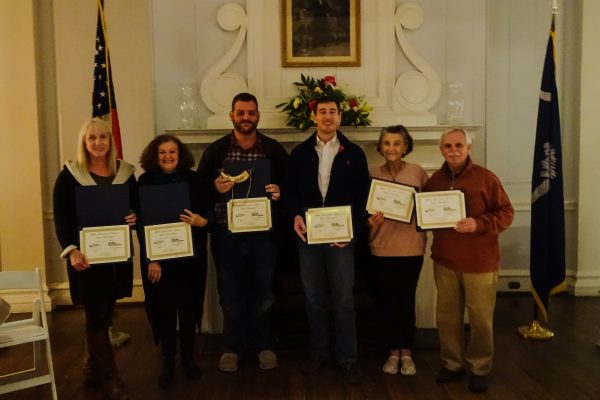
Today, the Great Hall is available for banquets, galas or for your special occasions.Go to Building Rental for more information.
|
|
Home | History | Plan A Visit | Education Programs | Building Rental | Gift Shop | Friends of Old Exchange | Related Links | Contact Us © 2001-2010
The Old Exchange -- All rights reserved. |