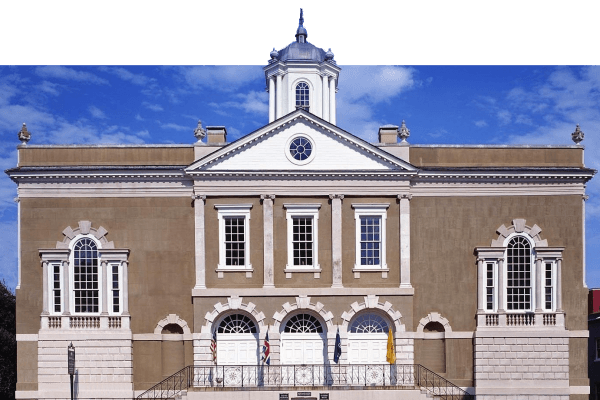

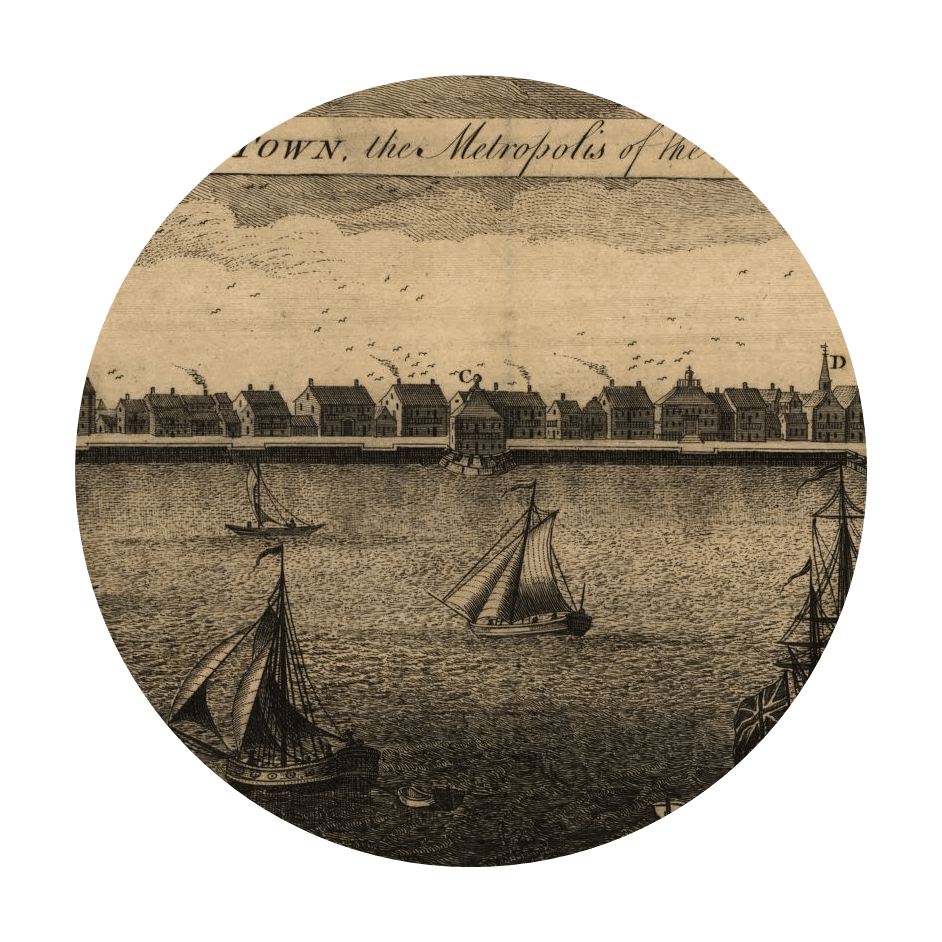
Beneath the Old Exchange Building lies the Provost Dungeon, which played an important role in the history of Charles Town, South Carolina and the development of our country. Sturdily constructed in 1781 using a brick barrel vaulted ceiling, the Dungeon, and the remaining floors of the Old Exchange Building, have survived hurricanes, earthquakes, and wars. Archaeological excavations have unearthed some fascinating artifacts, including a portion of the original Half-Moon Bastion, currently the only visible section of the early fortification of Charles Town. Here are historical accounts of some of the occurrences within the Provost Dungeon:

Edward McCrady, LL. D. in The History of South Carolina in the Revolution gives the following description of the Provost:

"The middle part of the cellar under the Exchange was the place chosen for the imprisonment of those arrested. It was called the Provost. The dampness of this unwholesome place, without any means of warming its temperature, caused great sickness and suffering and some deaths among those confined within its walls. It was in this place that the citizens arrested in August 1780 and sent to St. Augustine, were first confined. Citizens, marched from distant parts of the interior in irons, were thrown into this prison. . . . Not only men, but women also were indiscriminately cast into this place. Among these two young ladies of most excellent character and respectable connections, on a groundless suspicion of giving intelligence to the Americans, were for a short time subjected to the same indignity. These were crowded together with the sick laboring under contagious diseases, with negroes, deserters, women of infamous character to the number forty-six within narrow limits."

On August 27, 1780 the following prominent citizens who had been given freedom of the City under parole were arrested by order of Lord Cornwallis and imprisoned in the Provost of the Exchange and were later sent to St. Augustine, Fla. -- Lieutenant-Governor Christopher Gadsden . . . Thomas Heyward, Jr. . . . Edward Rutledge [ and 35 others].

On November 15, 1780, the following patriotic gentlemen shared the same experience of incarceration in the Provost of the Exchange: . . . Arthur Middleton of Middleton Place . . . [and 22 others].

--Way, William. The Old Exchange and Custom House--1767-1970--Charleston, S.C.
Charleston, S.C.: Rebecca Motte Chapter, 1970.


Barrel vaulted ceiling and columns provide
a structurally sound foundation for the
upper floors of the Old Exchange, but also
created an oppressive space in which
the British detained prominent Charles Town citizens
who were accused of giving intelligence to Americans.

In 1965, Charlestonian C. Harrington Bissell’s objective in restoring the cellars of the Old Exchange was to bring history to life--to recreate the experience of patriots held prisoner within the dank basement of the Exchange. Painstaking research was done in composing displays for the Provost Dungeon Museum. Local authority Emmett Robinson designed the scenes with accuracy and authenticity, and each life-size model represents a specific individual who was confined, as the records indicate. Visitors will notice that gentlewomen shared the cellars with patriots and common criminals, as well as with less-refined women of the age.

Bissell opened the Provost Museum in 1966. He subsequently received various awards for his efforts to reproduce American history in the cellars of the Exchange.

--Miller, Ruth M. and Andrus, Ann Taylor. Witness to History: Charleston’s Old Exchange and Provost Dungeon. Orangeburg, South Carolina: Sandlapper Publishing, Inc., 1986.


During the 1979-1981 renovation of the building, John M. Mitchell Jr., who acted as project architect, made some interesting discoveries. The vaulted ceilings of the Provost Dungeon are only one brick thick at the point of the vault, an engineering masterpiece. The vaults are leveled above with loads of sand to support the original purbeck stone of the main floor. In the sand, Mitchell found single unbroken oyster shells. It appears the workmen over two hundred years ago helped themselves to oysters growing along the riverbanks at the front of the building, ate the oysters for lunch, then tossed the shells into the sand they were using for fill.


Home | History | Plan A Visit | Education Programs | Building Rental | Gift Shop | Friends of Old Exchange | Related Links | Contact Us

© 2001-2008 The Old Exchange -- All rights reserved.
122 East Bay Street, Charleston, SC 29401
(843) 727-2165 or 1-888-763-0448


Historic images courtesy of Old Exchange Archives, SC Historical Society, Library of Congress,
Images of American Political History, and University of California-Riverside. All rights reserved.